Sunday, January 28, 2018

Turning 70

by Glenn N. Holliman

Recently I traveled to Israel and met a new Jewish-American friend, a few years older than me, and a person who has lived a large life.  As I sometimes do in a wonkish way after several glasses of the local beverage, I asked Ken what the word 'time' means.  Being socratically minded, he immediately asked me what I thought the word meant. 


Left, Ken, a scholar of Israeli history, and my cousin, Karen Holliman at Caesaria January 2018

Quoting another wise friend, David, a retired science teacher in England, I replied, 'Time is continued existence."  And Ken being a thoughtful theologian (although he would never admit it) asked pointedly, "Then what was time before existence?"  

Well, he had me there and still does, so this column in today's local web media caught my eye and spurred this Sunday morning increased reflections.  Especially so, since I now see 70 in a rear view mirror and realize my 'sell-by' date has arrived.

 No, I am no closer than this writer in knowing the unknowable, although my daughter is challenging my existential thinking these days.   Sigh....GNH

Right, David of the Midlands from England, a deep thinker and an inveterate traveler of the world.

 A Few Thoughts on Turning 70
by Bob Quarteroni of Pennsylvania

"The days of our years are threescore years and ten." Psalm 90:10

So there you have it.  According to the Bible the warranty on this puckered-up meat package is about to expire.
On Feb. 6, a birthday I share with horror with Ronald Reagan, I will turn 70, when the Bible says it's time to turn into a subterranean sandwich for the eyeless hungry.
It seems just yesterday I was making mud pies with Joanie Ondish under our grapevine and now look at me: Told by Scripture that my ticket is ready to be punched.
So, how do I feel about this?  Should I expound on some profundities, state some nuggets of wisdom that I've learned over the decades, impart important truths to those you younger than me?
The truth is I feel no wiser - no less ignorant about everything - now than I did when I was a freshman at Central Catholic High school shooting spitballs though straws at my friends.
Which is beyond frustrating, since my entire life has been focused on the one and only truly important question we all face: What does it all mean?
Why are we here?  Why were we born? What is life?  Is there a God? Is the universe entirely random?  Is this all a dream?  Is there even such a thing as reality?
All part and parcel of the same question, the ur-why, the meaning of the whole damn thing. 
I was born reflective and I've stayed that way.
Sixteen years of Catholic schooling (even as I rejected that religion's silly rote mumbo-jumbo) early fueled my obsession with understanding a universe so unknowable, so seemingly random, so inexplicably composed of fantastic beauty and evil beyond understanding.
And the following decades were quests for knowledge in a myriad of ways, from mysticism to Zen, from meditation to Thomas Merton, from existentialism to magic mushrooms, from Paracelsus to St. John of the Cross, from the Kabballah to Buddhism, etc. etc. etc. ad infinitum.
The result? Nada. I feel I know less now then when I was making the mud pies.
I feel exactly like the woman in Annie Dillard's transformational - for me - "Pilgrim at Tinker Creek."
"We wake, if we ever wake at all, to mystery, rumors of death, beauty violence.....'Seems like we're just set down here,' a woman said to me recently, 'and don't nobody know why.'"
Amen to that, sister.
After a lifetime of trying to understand, it's no clearer to me now if, in the terms of one of my King's College theology courses, there is an "unmoved mover" behind it all. Or if it's just random chaos, noise, interference, indifference.
As "2001" author Arthur C. Clarke put it: "Two possibilities exist: either we are alone in the Universe or we are not. Both are equally terrifying."
Anyhow, thanks to my limited intelligence I'll obviously never know the answer. I almost hate to trot it out because I use it so often but it's so perfect: Alfred North Whitehead's "The universe is not only stranger than you imagine but stranger than you can imagine."
And I think that would be the case. Whatever's going on is going to be so fantastically weird and complex, we wouldn't understand it even if it was served up in tiny slices for our tiny brains.
It would be like trying to teach the theory of relativity to a flatworm. Not gonna happen.
So, leaving the great profundities aside, what have I learned in my 25,550 days?
I've learned that life is both sweet and sour. I've lived a thoroughly messy life and I wouldn't change a minute of it, not even when I screwed up the most or was most heartsick.
It's been an enjoyable, sloppy mess, full of loves and hates, likes and dislikes, adventures and misadventures; a roller coaster of loud, hard, intense living that is getting to the end so fast that it takes my breath away.
Did it have any great meaning? I would think not, though its memories and illuminations are priceless to me and will be until I blink out.
While the jury is out on the cosmic riddle, I strongly believe there is no afterlife, no personal Bobby Q floating around in the ether for eternity doing - what exactly?
That seems so silly to me to not even be worth serious consideration. No, as the ancient Easter Island proverb goes: We are born, we eat sweet potatoes, and we die.
When the rough beast I am slouches to a stop, that will be it for me. Nothing will be left but other people's memories of me and a room-temperature husk, devoid of life and meaning.
But I don't find that depressing at all. It's been a good run for a little dust mote like me, one helluva ride.
Even though I've never found any answers, I've never stopped looking and questioning, wondering and hoping, seeking and probing.  And that, for me, has given meaning to my life.
On his deathbed Rabelais said, "I go to see a great perhaps."
Soon, perhaps, so will I.
Bob Quarteroni, a frequent PennLive Opinion contributor, is a former columnist and editor at the Centre Daily Times. He lives in Swoyersville, Pa. Readers may email him at bobqsix@verizon.net

Wednesday, December 6, 2017

Grace is my daughter, on a career path and a busy wife and mother of two daughters.  She and I both wish she had more time to write, because when she keyboards her thoughts, prosaic articles such as this appear. - Glenn N. Holliman

This Is It
by Grace A. Holliman

I am a licensed massage therapist. Recently I went to see an older client who has never wanted to talk with me about her numerous health challenges. She is now on oxygen after a pneumonia scare last month. She is attached to a tube that is connected to a machine that makes a constant ebbing and flowing sound that regulates oxygen pressure to help keep her as independent as possible. After our session I asked if she was going to be able to get off the oxygen.    


For the first time in seven years she looked me in the eyes and spoke of her health in full truth, “No, this is it.” 

There was a pause. A holding of space. We were both comfortable with the uncomfortable. We didn’t push it away, cover it up, or avoid anything. A long, thoughtful conversation occurred between us after that moment. 

In his book, The Five Invitations: Discovering What Death Can Teach Us About Living Fully, Frank Ostaseski wrote, “Accepting life ‘as is’ means we make peace with things as they are rather than trying to force them to be the way we want them to be-and getting frustrated when we can’t.” 

I believe that accepting life “as is” creates freedom and allows one to experience life fully, which is not easy to do. Accepting doesn’t mean we give up on loved ones, turn off the oxygen, or agree with what is happening around us, but we don’t waste time and energy lamenting the past or trying to control the future.

I’m writing this as an observer of the human condition. I try to put myself in the place of those I see suffering, especially the caregivers of the hospice patients I visit, but ultimately, I can’t. 

I am often reminded of the story of a Buddhist monk who finds his teacher crying on a hillside. The monk asks his teacher, “Why do you suffer?” The teacher replies, “My son has died.” The student says, “Are we not taught that we create our own suffering through attachment.” The teacher looks at his student through tears and says, “Yes, but my son has died.” 


Saturday, November 25, 2017

Europe and the U.K.

Europe is Experiencing Two Forces, which the British Press Misdescribe by Terry Field

The economy of continental Europe is recovering, with real and substantial growth happening, and with major areas of innovation showing real sparkle and success.

These are early days, and large areas of Europe are not having such a good time, but that is to be expected, as the shape of the economy changes, some areas decline, some activities remain permanently depressed to the point of collapse as other areas previously poor suddenly become wealthy as the dice of capital spending fall where they must. Thus, in Germany, the appearance of a new right wing force that has nearly 13% of the Bundestag expresses both anti-migrant fervor and dislike of Europe. 

Terry at his home in Florida, looking through his camera into the future?

A quick look at the map shows where this is happening. It is happening in the extreme east of the country bordering on Poland. Poland, and un-indebted country, with still very low wages, has sucked economic life from the German neighbouring regions as it has grown fast and furious for a decade now. The same for Germans near the old German Sudeten Czech border lands.

The British press, generally right wing, and nearly always nationality-obsessed as they always are, suggest that this new 'nationalism' will derail 'Europe', yet the real evidence of what is happening suggest the reverse.

The first thing to observe is that there is no call for national assertiveness from many of these 'marginalized' Germans. It was interesting to listen to a local German station interview Germans who had voted right-wing and who lived near the old Sudeten border. Of all borders in the world, this one sears the mind of those who have a bent for history as being similar in its banner of tragedy to that of the border between India and Pakistan. In the Sudetenland, firstly, the Slav peoples living there were expelled by the German government when it as annexed by Hitler. Then, after the collapse of the Reich, the reverse was done to Germans- and with a bloody and dreadful vengeance.

It therefore came as a surprise that these modern, poor Germans, when interviewed, said gleefully that they would like to swap and become ‘Chech Sudeten Germans’ and leave Germany proper!

Why? Because that part of Czech is doing very well thank you.

In other words, for you nationalists who are obsessed with the nation state, the real message of the political developments in Germany, now with a Chancellor unable to form a proportional representation coalition - is that the problem, not the solution - for these people - is that they are subject to a German national and federal budget. Their distress is NOT making them look to a 'greater' Germany. Many wish to become Czech!

Because they will be prosperous, or so they think. 
Of course, the border with Poland excludes such dreams, history and prejudice being what they are. But these old 'Ossie' Germans are the old, stranded folk as their children moved to Frankfurt, Wuppertal, the rich Rhineland and the southwest to prosper after the wall fell. These poor old folks living on cracked socialist dreams are no argument for the nation state at all.

Even they recognize they are simply the flotsam of history. Self-pity and morbid introspection should be, and is, is the dominant emotion there, not nationalist fervour. Nigel Farage (United Kingdom Independence Party leader) was reported to have been engaged with this political uprising. Some uprising.

All it does is destabilise the Chancellorship for a period. But the solution here is European wide intervention. These marginal areas where misery has descended require the subsidies the immobile old live by. 

Nobody can or should imagine Europe is a failed idea because of this. It would be like saying the sea is not the solution for the life of fish, after a pod of pilot whales, stranded and dead on the beach have been observed.

Labour mobility and open borders are the solution here. Subsidy is needed. All else is irrelevant. National context is a simple irrelevance for these people, but it is a massive problem for Europe.

Plainly the German political structure amplifies division and it was designed to do so. The dominance of the German state in Europe is a problem for Europe, and the political incapacity of Germany points a searchlight at the need to radically reduce the power and political dominance of the nation state in the context of Europe. If that does not happen, Europe will fracture further, and it may disintegrate entirely. Yet that will simply impoverish all the members.

Right, an adult and adolescent owl resting on a tree branch at Terry's domicile in Florida.  Wisdom is present in many cultures.  Photo by Terry, 2017.

 The truth of the failure of the idea of the all-powerful nation state in Europe is the central reality. Many may deny that, may 'rally to the colours' in ignorance and superstition, but their success will be pyrrhic. In Europe, nationalism is self-defeating. Impoverishing. Diminishing of all aspects of high-functioning human life. Polish ultra-nationalism strands poor Germans unfortunate enough to live on its border. I know of no circumstance where nationalism in Europe offers anything worthwhile, good and true.   

Brexit and a Paralyzed Chancellor

Frau Merkel, always treading on eggshells, now has crocodiles hatching under her feet. There is now no appetite at all in Germany for kindness to Britain; rather they are enraged by us. 

British politicians claim the Spanish are 'arguing Britain's corner' (and if that is not grasping at straws I do not know what is), yet they publicly deny it and call the British political class utterly deluded.
Robust European economic growth will take much of the quite small sting the continent will feel at the British leaving with no comprehensive trade deal. It will be ruinous for British trade, however.

The rise of disparate political nationalism in Austria, Germany, Poland, Slovakia. Czech, Hungary, imperil the freedom of movement of the great political regions of Europe - found in France and Germany - and that pushes them harder now to cut Britain out utterly.

Europe as a political entity is more uncertain than ever, flanked by weak, self-destructive nationalist members, and not moving to secure its social fabric as it must. 
In such a context a rabidly nationalistic Britain is more and more hated. And emotions drive policy.

Britain faces social disorder now based on nothing more than its present, known lamentable condition.

It is visibly moving out of the company of advanced humane forward-facing nations. That is palpable to all interested enough to see with clear eyes. 

I repeat what I wrote at the point nationalism tore my country into its present path. I love my country with a passion, but that love is directed at a Britain that was dying fast at the time I was being born.

Now I shudder at its future, and that of my beautiful step-children, and my exquisite step-grand-children.

On November 23, 2017, Terence Field wrote:


Today I read that the British IFS (Institute of Fiscal Studies) identifies suggests the debt profile will not recover to that of 2008 until 2060. 

I had penciled in a thirty-year period, ending about 2038, but they pencil in an additional twelve years.

Why?

Many reasons, related to extremely poor absolute and relative productivity, stubborn failure of the governments of the nation to adjust the pattern of the economy away from a 'rentier' be, and the consequent continuing need for incremental net state borrowing to allow spending 'commitments' to be met.

There is a projection of low growth of about 1.3, 1.4, 1.5 percent per annum. This is insufficient to maintain full employment in normal circumstances, but there are now no normal circumstances, thus more and more 'working' people will be paid insufficient to live, and state income subsidy will be required to increase and increase.

The world outside Britain grows well and strongly. Save for only two other economies in the entire world of economic activity, Britain exhibits persistently falling real incomes.
Poverty desperation and social dislocation is becoming the experience of a larger and larger proportion of the British people.

I could expand to describe an even grimmer picture, but frankly there seems little point. What is written here is quite sufficient.

Productivity, Camels and the Sahara Desert

I note that since the decision of the uninformed mob - in contrast to that of the 'Will of the Nation in Parliament Assembled' to exit the European political and social enterprise, inward economic investment has collapsed to a net negative-  a dis-investment. And that is simply the first reaction. No investment, and negative investment, after a few decades, makes the output resemble that of the Toureg in the Sahel. Productivity is all an economy has. Without productivity, there is no economy. It is core, fundamental, not a matter of trivial relevance.

The Brexit fantasists abused rational people as 'scaremongering' when we described the dreadful long-term consequences of this deluded nationalism. In reality, all we have seen so far is a pale imitation of what is to come. The chilling projections and current economic metrics are without the effect of real Brexit.

The immense productivity gains experienced in the advanced regions of the developed and the rapidly developing world eluded Britain. Britain is an anachronistic island - in every sense and not just the physical - of antique, rentier economy, broken class-ridden politics, society in a state of incipient violent disorder (even predicted by current serving ministers) and almost entirely bereft of the plastic, highly-educated, functionally literate population required to allow for the vital continuity that a changing, broadly creative and fully productive society vitally needs,

Brexit will add to the woes. And not to a trivial extent.

There is utter contempt for the posture and level of competence of the British government in Europe. 

The world is aghast at the political collapse there. The Dutch prime Minister stated that Britain's society, economy, politic was in a state of developing collapse. He was correct. 
We see it happening before our eyes.

There is real deep-seated re-assessment of the condition of Britain in all the chancelleries of the world. And the re-assessment is in one direction only.


What do the Brexit people imagine this will do to the continuing commitment to invest, to engage, to risk with and to apply executive thought in the direction of Britain? The answer to that is simple. They have not got a blind clue.

David Lott Visits the USA and has Some Reflections

Musings on a trip to the USA and other Things
By David Lott, Englishman, Political Observer

My granddaughter has just started an 8-year course to become a veterinarian. She is a US citizen and has worked immensely hard for her place at Colorado State University at Fort Collins. Kathy and my visit there was a real eye opener - the campus is truly superb and the facilities outstanding including accommodation for the new intake.

David's wife Kathy and granddaughter Linda at Colorado State University


It was the first time I have visited a grand ‘child’ standing largely on her own two feet and if the quality of her and her classmates is anything to go by, then the USA has little to worry about. Linda has a mind of her own and an opinion upon many if not most of the major issues of our times.  She also has that rarest of things in today’s world; an open mind!

She works very hard indeed as she will not know for the best part of 4 years whether she will be accepted for the following 4 years at CSU to achieve her aim. She will get a degree after 4 years but to succeed she needs exceptional results to go on to become a vet. Especially at this university at Fort Collins, Colorado as it enjoys a reputation in her field second to none.

Such a level of determination needs feeding, and we had a couple of outstanding meals in the delightful town with up market and interesting shops and restaurants. It is a highly sophisticated place as is Denver our next port of call.

In Denver we were brought up to date by our erstwhile neighbours in France. They owned the Chateau at the end of a tree lined avenue at the other end of which stood our rather more modest abode. Although our politics are a little different (they definitely do not support President Trump) they are fair-minded and we covered a lot of common ground. We found Denver a hive of building activity; the city is an upcoming major centre with high tech moving in with a great deal of money.

On a relaxed 10-day journey from there to Houston, Texas we saw much, with glorious views and autumn colours, abounding in the Rockies.


In western New Mexico we were staggered by the sheer scale of fracking for oil and gas. A vast area of largely poor sage brush land is being developed, and it continued without a break for 70 miles either side of the road deep into the hinterland. It was truly humming with large RV and mobile home parks for temporary workers and what seemed like thousands of trucks and construction sites. The US has the space, the resources, and the will to make this work. To be independent of the Middle East in terms of energy production seems a laudable goal.

Houston some 5 weeks after hurricane was bewildering. It was immaculate! We did not see it all of course because of the size of this huge ultra-modern conurbation but we did see much of the western side including the city centre. Everything but everything was in perfect order. What a testament to the authorities and their preparedness for this event and the way the water levels were managed during the storm. Our local authorities England would have been out of their depth!

My son and his family live just outside the city. Their daughter was away in Fort Collins of course and the first to have flown the nest. He is in the oil business as a senior engineer with Mitsubishi. They own a house which probably cost the same as our modest house in West Sussex but it is large airy comfortable with a very grand staircase and would cost treble the price if it were in southern England. My daughter-in-law likes President Trump’s policies but not the man himself which seemed to be true of quite a few residents.

Throughout the trip I intentionally wore a cap with ‘Make Britain Great Again’, emblazoned on the front. It was a pleasant surprise that people loved it even in New York. It seems that citizens throughout the west love their customs, way of life, food cultures and history all of which give a country its identity wherever you are. Those with a globalist agenda cannot seem to grasp this basic urge.


By globalist I do not mean those wanting free trade alone but those with a different agenda that includes the deliberate imposition of mass immigration. Such dismantling of borders as outlined as an ultimate aim by Hillary Clinton and here in Europe by the leaders of the EU and enthusiastically endorsed by Angela Merkel have led already to increased crime, terrorism and unrest.

David's wife, Kathy, and son and daughter in law in every growing Houston, Texas!

That political parties labelled ‘extreme’ are on the rise comes as a result of the blindness of their leaders. Nor do I subscribe to the idea that the US has no identity because of a shortish history. Indeed, it was abundantly clear in New York that rich, poor and the in between mix wonderfully there. Whatever the race, they are all New Yorkers and American despite the mix. It is what makes the place so vibrant. But this is a triumph of assimilation not isolation within communities.

So from New York it was home on the magnificent Cunard ship Queen Mary 2. During a live performance on board in the middle of the Atlantic we were hit by a rogue wave in a relatively calm sea. The act was a single female singer accompanied by a pianist at a grand piano. As the wave hit the piano started to slide but the pianist bravely continued to play! The piano continued to slide, and the singer rushed to help the pianist desperately now pushing back against the weight of the piano whilst still half sitting on his stool. They were joined at last by a stage hand and as the ship righted the slide was controlled and stopped. Whereupon the pianist sat down, the singer returned to her microphone and together they picked up the song at exactly the point at which they were interrupted to the tumultuous cheers of the audience! Tres cool.


On the QM2 there are educational and current affairs talks and I was so pleased to hear a New York Times journalist give a series of talks on the state of US politics with particular reference to President Trump and Hillary Clinton. I expected him to excoriate Trump and praise Hillary, but he was scrupulously fair and honest about the two of them. Maybe some of the MSM are getting the message that ‘honesty is the best policy’!
We also had a geologist talking about the energy industry and he too captured his audience’s attention. The last of his lectures concerned climate change. Using data from eons ago to the present day, much of it from a geologist’s perspective, he debunked the idea that man is altering the climate. That the climate is changing he agreed but very gradually, naturally and independently from Man’s activities. The geological activity that results below and above the sea resulting in volcano and geothermal activity utterly dwarfs any small impact by man was just one of his compelling arguments.

And so back home to Blighty where the irrelevant pygmy politicians of the UK were still betraying our Brexit vote and arguing, speculating and pontificating on much but dealing with nothing. It seemed at the same point where it was before we left a month before. How deadly.

But we live in an old fashioned little town at the foot of the South Downs and the countryside is glorious. And at the age of 77 I start a new part time job in February for a few days a month as a volunteer guide at the Tangmere Military Aviation Museum. Tangmere is where my father was based in 1940 where he commanded a Hurricane squadron in 1940. It also houses a Harrier aircraft that I flew several times 40 years ago! It is all very apt.

Toodle Pip David Lott, retired pilot and RAF officer and whose father was seriously wounded in the 1940 Battle of Britain


Down Under Visits the North Country, Part 6


Niagara Falls, Niagara on the Lake and a Reflection
by Stephanie McCarthy of Australia

On a Sunday in July 2017 Nancy and Ron Marshall drove us to Niagara, but they had carefully planned our first view of the Falls from the room they had booked at the Marriott – sixteen floors up and seemingly perched above the very edge of the mighty Falls.

Our first view took our breath away, just as our hosts had intended. Ron told us the incredible story of how a seven-year-old by the name of Roger Woodward (no, not Australia’s famous classical pianist) had survived going over the Falls after his Uncle’s boat had capsized upstream. When we finally descended to take a closer look, and gazed at the unfathomable power of that plunging water, Roger’s survival seemed even more miraculous. Someone told me that in a half second the volume of water dropping over the Falls would be more than Alice Springs in the heart of Australia would receive in a year’s rainfall. I hate the over-used word ‘awesome’, but it must be used about Niagara Falls, especially when seen from the Canadian side of the border.

Later that afternoon our friends Glenn and Barb Holliman, who had driven most of the day to be with us, arrived at the Marriott. On the sixteenth floor, overlooking those wondrous Falls, we nibbled at delicious pre-dinner food prepared by Nancy and lifted our glasses to each other in pure joy at all meeting up again. Towards evening Glenn drove us to the Riverbend Inn at Niagara on the Lake. This gracious and beautiful chateau set amongst acres of grape vines became the venue for a very special meal.


 Left, Ron, Maurice and Steph before dinner.

My mother, who is too infirm to have made the trip, treated us to this feast and this time we toasted her. As he’s always done, Glenn asked profound questions about the meaning of life in that deep hypnotic voice of his, and it took only a few dreamy hours to solve all the world’s problems. At least I think we did.

Maurice and I then found our way to a room in the chateau fit for a king and queen and ‘given’ to us for the night by Glenn and Barb, and we felt as if we were in some wonderful dream – the kindness of our Canadian friends will be hard to match if ever they can make it to South Australia, but we’ll try.

Barb Holliman has been coming to Niagara on the Lake since she was three years old, and she applauded the fact that it has retained its charm and beauty and class despite the huge growth in population and tourism.

In the magnificent Prince of Wales hotel, we sank into leather chairs and ordered refreshing drinks and pretended we really were royalty. Eventually Barb and Glenn had to set off for their home in Pennsylvania, and the Marshalls took us back ‘home’ to Kitchener. 

Below, the Prince of Wales with Maurice, Barb and Ron.  Right, flowers at Niagara on the Lake, Ontario.


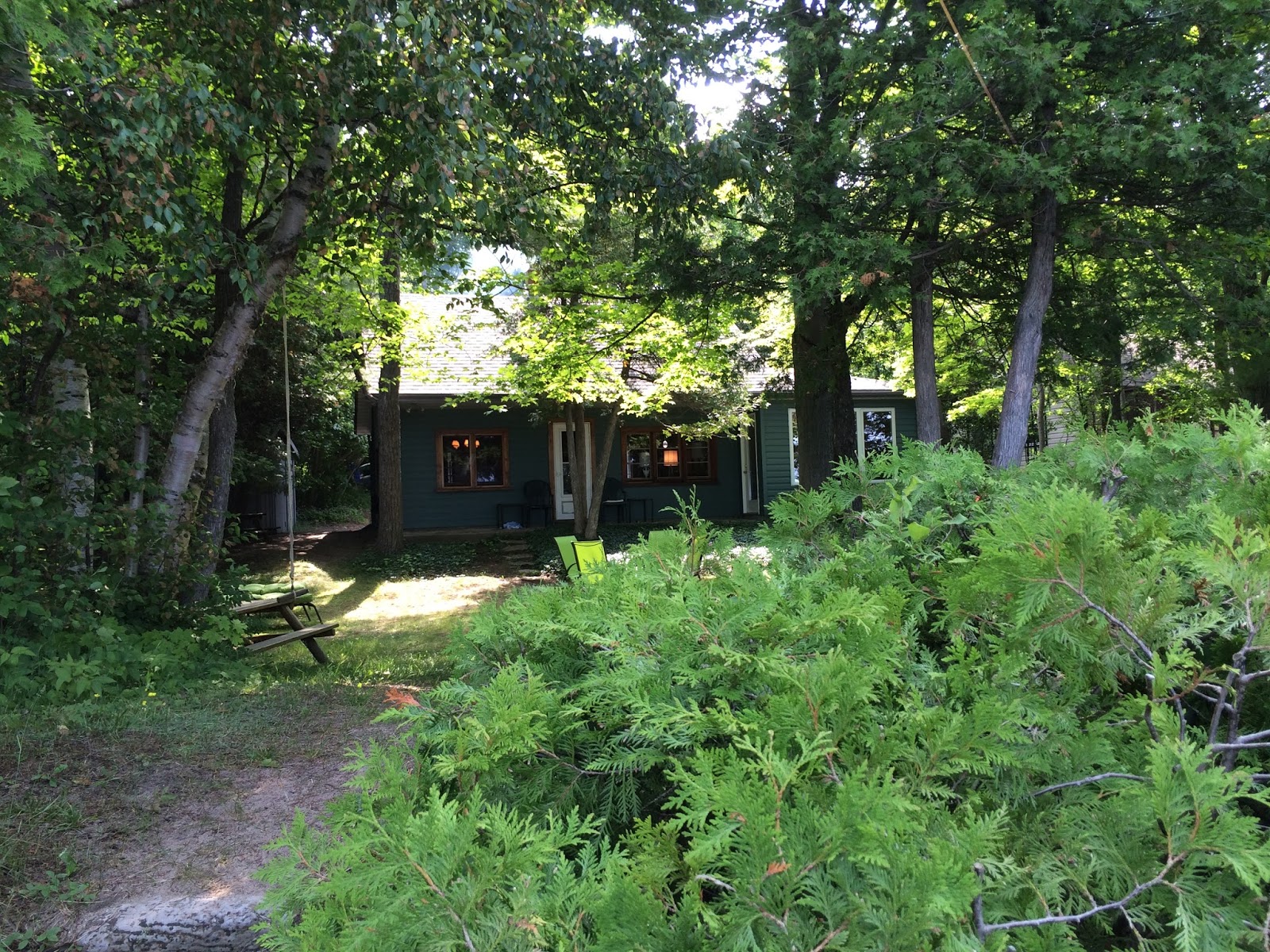
The next day we set off once more on a long drive, this time to their cottage on Lake Huron. And what a little honey that cottage is! Secluded in the woods adjoining the Lake, it was built by Nancy’s father, and extended by Ron who is no slouch with the carpenter’s saw. The warm glow of wood everywhere, and little treasures washed up by the lake or given by loved ones are all around to delight the eye. 

We sauntered along the lake’s edge, seeking weird and wonderful stones, and I was thrilled that Ron shares my passion when it comes to rocks.  At one stage his pockets were so full of rocks big and small, his trousers were in grave danger of falling down.

Right, the rocks and shoreline of Lake Huron.

Back at the shady dell in front of the cottage I was persuaded to have a ‘swing’ game with Ron. This involved me arcing higher and higher on a conventional swing, while he perched on a table on a stick swing and judged to time to hurl himself off the table towards me. One foot of his and one of mine touched, but the aim was that both of our soles should meet at the same time. Once more he judged his moment and swung to meet me and bingo! Our feet met. By this time, I was laughing so hard I could barely see, and began to imagine I was eight years old again. And so, when I was still in mid swing I jumped. A million times I did it when I was a kid, my backside gliding gracefully out of the swing, my body arcing in the air, and two feet landing firmly on the ground.

Steph's dangerous swing in the back-shaded lawn facing Lake Huron.


Well, this 68-year-old launched herself from the wooden plank, flew through the air with the greatest of ease, and then all is a bit hazy. I think I landed on my feet, but the momentum was too great, and I lost the desperate struggle to stay upright as I staggered and fell. One day perhaps I’ll act my age, but I doubt it.

During the afternoon Ron taught Maurice the art of paddling the Canadian canoe, and when that was mastered he produced two kayaks. Maurice had a sixth sense this might end up a wet exercise, so he shed clothing until he was in nothing much but board shorts and lifejacket, and the pair set off to compete in fetching a stick. Maurice kept reaching the stick first and therefore was the winner (so he maintains) but after a while began a jostling of paddles and nudging of kayaks and muffled shouts. Maurice’s kayak began to lean dangerously for several seconds before ‘splash!’ and he was christened in Lake Huron. With insincere condolences Ron very decently helped his Australian mate, who nearly drowned laughing, to shore. One day, Maurice vows, he will have his revenge. Maybe he will take Ron out to sea from our beautiful Brighton Beach in a catamaran one hot day in summer, and an accident just might happen when they go to turn about, or ‘aboot’ as the Canadians insist upon saying.

 Above the cottage on Lake Huron....

It was time to catch a series of planes home to be greeted by a jealous family all struggling to get warm in grey wet and cold South Australia. What an irony – to tell them that we’ve been gallivanting in T-shirts in sunny Canada. The warm glow of Canada and Canadians is still with us despite the wintry weather. We honestly feel as if we’ve been given the very best tastes of the land of moose and maple leaf – nothing studied or thought about too much, just tastes and flavours and glimpses, but we are certain that profound memories of that remarkable three weeks will stay with us for the rest of our lives. – Steph McCarthy, traveler extraordinaire


Sunday, October 15, 2017

Down Under Visits the North Country, Part 5

Stephanie  McCarthy continues her log of the trip she and her husband took to Canada this past summer.  From Australia, Steph records her observations of the quaint cousins of the North County of North America! - GNH


At Kitchener we were greeted by the Marshalls, friends of Glenn and Barb Holliman, and from then on we were dreadfully spoiled. Nancy and Ron made it their mission to pick us up every day from our B&B and take us somewhere different and interesting. Immediately we felt at home in Kitchener, not just because the Marshalls made it so, but because in many ways it is similar to our city of Adelaide – an unhurried atmosphere, wide streets, gracious old Victorian buildings, lots of lovely trees….

Ron Marshall of Kitchener explaining how a camera, not a telephone, works to Maurice and Steph.  The statue is typical understated Canadian art.

But one aspect of Kitchener and the farmlands surrounding it was unexpected and quite fascinating. This was evidence of the Mennonite community, with their neat-as-a-pin farms, their women in long dresses and transparent bonnets, their men in trousers with braces, and straw hats with a black band. 


We saw plenty of children at play – dressed exactly as their elders. We saw Mennonites in buggies pulled by horses (ex trotters), and the draft horses set aside for the hard ploughing work. Most of their farms were not connected to electricity, but there is what Nancy calls a ‘continuum’, a new order where some of this next generation is choosing to engage partly in the modern world, while endeavouring to keep the worst of Western vices at bay.

I had some worrying questions, such as ‘Are the girls being held back from further education against their will?’ and ‘Are there exclusive Mennonite schools?’ but even after googling I’m really none the wiser, except to say that yes, there evidently are some Mennonite colleges and schools, some accepting funding from the Canadian Government, some not. All I can say for sure is that the Mennonites I met in their restaurants, cafes and gift shops seem to be genuinely healthy (none were obese) and happy, with no desire to push their way of life and beliefs on to anyone else (unlike some religious groups who spring to mind).


Although we never went near a French province, we found the French language at every turn, not spoken by the populace but ingredients written on almost every product in the supermarkets, and instructions given on every aircraft flying within Canada. Given that Google claims the small minority of Canadians who speak only French is 1.5%, I really feel this must be political correctness gone mad.  

Right, Pete and Steph in Toronto, Ontario.

We spent one full day in Toronto, a city with many attractions. Kim and Pete whom we knew from times past took over from Nancy and Ron and became our tour guides, driving us first into a ‘ritzy’ suburb where the rich and famous live in mansions with an average price of $8m give or take a dollar. Some of their gates would have cost half the value of our house, and most of the ‘castles’ made us gasp, but I wouldn’t have swapped our homey home in the Adelaide Hills for any of them.


 Toronto and the tower and the Australians.

Kim and Pete then took us to the ‘alternative’ suburb of Kensington, where we sauntered up and down one narrow bustling street for hours, marveling at the unlikely characters, the unlikely artwork which included a car chassis growing a healthy garden, and the unlikely shops, one of which offered ‘rolled ice cream’ and had an open window featuring a young man demonstrating the process from start to finish. By the way, my tub of rolled berry ice cream was sensational.

Our guides then drove us sedately through the gracious university grounds where several Asian brides were being photographed with the Victorian buildings as impressive backdrop, and suddenly we spied the full CN building in the far distance, framed by a narrow road. 


When we reached the tower the crowds were so dense that we needed to buy our tickets and return in two hours, so we headed for the nearby harbour boulevard. It was a vibrant scene, and the sun sparkled from the waters of Lake Ontario so vast that if our guides had not insisted it was a lake, we would have assumed it was the sea. The yachts and cruisers made a gorgeous sight, and we mingled with the crowds until it was time to head back for the CN tower. I relished the ride in the glass lift all the way to the top, and thoroughly enjoyed my eagle eye view of Toronto. My only discomfort, rather than the dizzying height, was the sheer press of humanity all about me.

More next posting!